Opening soon. Get your price and request a booking now, and a person will email you within one business day about a time that fits your days. You pay nothing until you pick a time.

Guide · BBQs
Getting your BBQ ready for summer
Getting your BBQ ready for summer usually takes about an hour and eight checks: gas off and the bottle looked over, hose and regulator, plates, burners, fat tray, hood, a salt-air wipe-down and a 10-minute test burn. Do it in late spring with the BBQ cold. If you find a gas leak, a cracked hose or a flame that stays yellow after cleaning, stop and call a licensed gas fitter.
Updated 20 November 2026 · Ember & Leaf, oven and BBQ cleaning from Tweed Heads to Ballina
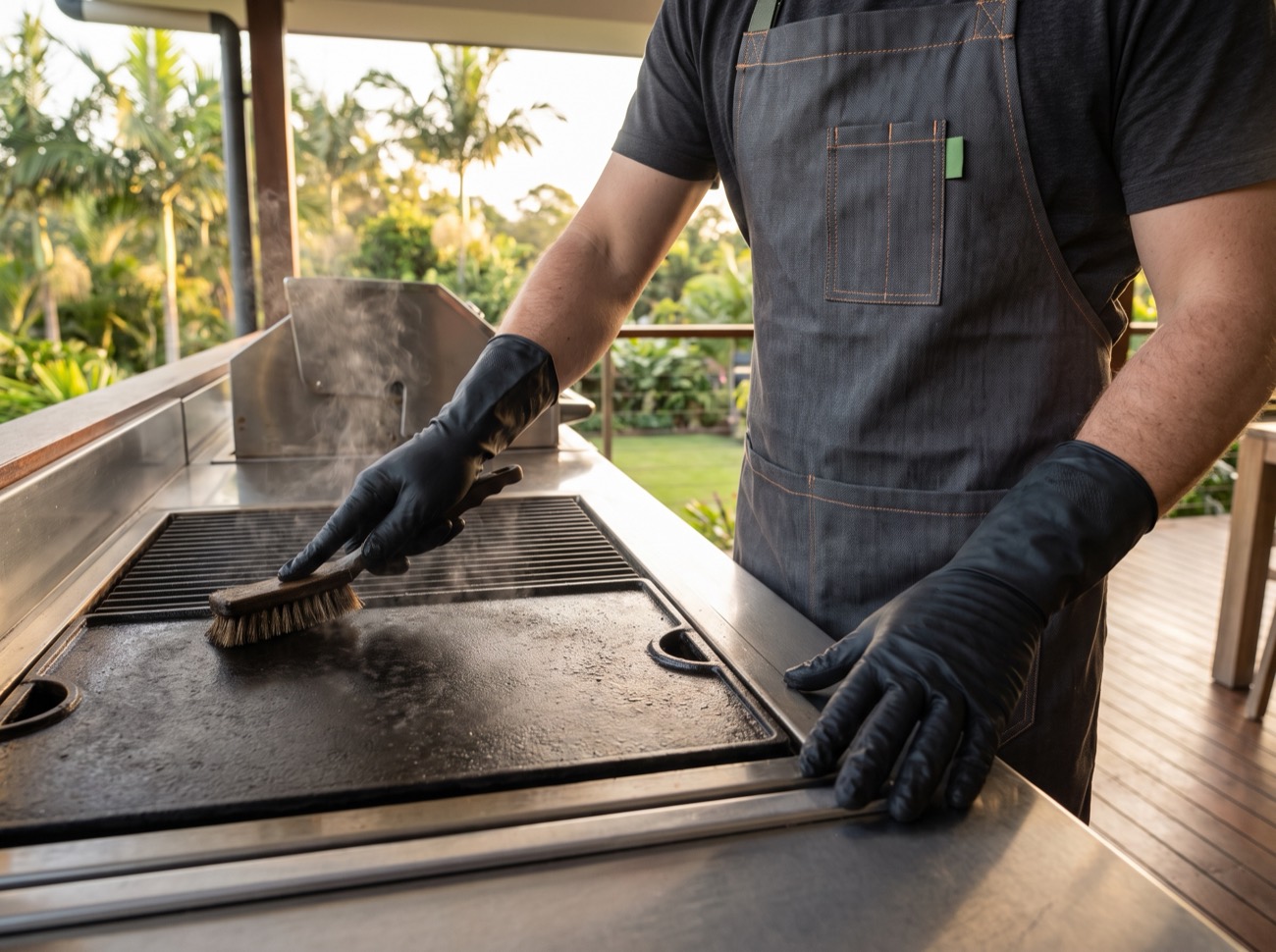
The late spring BBQ check at a glance
Work top to bottom. The gas checks come first because they matter most.
Check
What to look for
If it's wrong
Gas off, bottle
Rust, dents, a damaged valve, a test date stamped on the collar
Swap or replace the bottle through your supplier
Hose and regulator
Cracks, cuts, scorch marks, stiff or kinked hose, corrosion
Licensed gas fitter
Connection
Bubbles when you brush soapy water on it
Valve off, don't light it, licensed gas fitter
Plates and flame tamers
Thick grease, flaking carbon, rust
Clean, or replace the part
Burners
An even blue flame, clear ports
Clean the ports. A flame that stays yellow or lifts means a gas fitter
Fat tray and the area under it
Old fat, ash, leaves, nests
Empty and degrease
Hood and firebox
Carbon flakes, grease, rust at the hinges
Scrape, degrease, dry
Test burn
Every burner lights and runs for 10 minutes
Note the one that doesn't
Before you start: stay safe
Work outdoors or somewhere well ventilated, with the BBQ cold and no naked flames or smoking nearby.
Wear gloves and eye protection when you scrape or degrease.
If you use any cleaning product, follow the label and your BBQ manual.
Check your grill and plates for loose wire bristles if you've used a wire brush. They can end up in food.
1. Gas off, and look the bottle over
Turn every control knob to off, then close the bottle valve by hand. Check your manual for the direction. Then look at the bottle itself:
01
Stand it upright in a shaded, ventilated spot, never indoors or in a cupboard.
02
Check the test date. It's usually stamped on the collar. If it's out of date, swap the bottle through your gas supplier or exchange.
03
Look for rust, dents and a damaged valve. Heavy rust or a bent valve means the bottle should be swapped, not used.
04
Lift it. If it feels nearly empty, get a spare before the first big weekend cook.
2. Check the hose, regulator and connection
With the gas still off, run your eye and hand along the whole hose:
Cracks, cuts, brittleness or a hard, stiff feel.
Scorch marks or melted patches where it has touched a hot part.
Kinks, or a hose that's dragging on the ground or hanging against the firebox.
Corrosion or damage on the regulator.
Then do a soapy water check, which most manufacturers describe in the manual:
01
Mix a little dish soap with water.
02
Brush it over the connection at the bottle and the other joints you can reach.
03
With the control knobs still off, open the bottle valve slowly.
04
Watch for a minute. Bubbles that grow or keep forming mean gas is escaping.
If you see bubbles, close the bottle valve, don't light the BBQ, and call a licensed gas fitter. Don't patch it with tape or keep tightening it. A strong gas smell you can't stop, or a hissing you can't trace, means move away from the BBQ and call 000.
3. Plates, grills and flame tamers
Lift out the grill plates, hotplates, warming rack and flame tamers (some BBQs use vaporiser bars). Scrape off the loose carbon with a plastic or wooden scraper. Soak the parts in hot water with a little dish soap, then scrub and rinse them. Dry them well, because damp metal is where rust starts.
Look for:
Flaking enamel or coating. It can end up in your food, so replace the part if it's coming away.
Rust. Surface rust on bare cast iron or steel usually scrubs off. A part that's rusted through needs replacing.
Warped or cracked flame tamers. They protect the burners from drips, so it's worth replacing a bad one.
4. Burners: ports, flame and spider webs
Lift out the burners if your model allows it. Check your manual first.
01
Look at the ports. These are the small holes along the burner. Brush them clear with a proper port brush. Never use anything that makes the holes bigger.
02
Check the venturi tubes. These are the short tubes that feed gas to each burner. Spiders like them, and webs are the usual reason for a lazy yellow flame.
03
Refit, reconnect and light each burner one at a time, with the lid open. Do the soapy water check again on anything you disconnected.
04
Read the flame. A steady, mostly blue flame along the whole burner is what you want. Yellow, lifting, popping or patchy flames after a good clean mean a licensed gas fitter should look at it.
If a burner has rusted through, don't try to make do. Get the right replacement, and ask a licensed gas fitter if you're not sure about fitting it.
5. Fat tray and the area underneath
This is the part most people skip, and it's where a flare-up starts. Slide out the fat tray, tip the old fat into a sealed container for the bin, and scrape and degrease the tray. Then clean the area under the BBQ: leaves, ash, spilled fat, and any nests. Empty the tray before it's half full from now on.
6. Hood and firebox
The black flakes that fall onto your food are usually carbon from the inside of the hood, not paint. Scrape the inside of the hood and the firebox with a plastic scraper, degrease them, then rinse and dry. Look at the hinges and the lid corners. They're where rust shows first.
7. Salt air: the Tweed to Ballina problem
Salt sticks to everything outside. On a greasy BBQ it holds moisture against the steel, which is what causes the brown tea staining on stainless and the rust on burners and hood hinges. The closer you are to the beach, the more often it needs attention.
Where you are
Full clean, usually
Between cleans
Within a few kilometres of the beach
Every 6 months
Wipe the stainless dry after rain or a sea mist
Further inland
Every 12 months
Wipe down after a big cook
What helps on the coast:
A fitted cover, on whenever the BBQ is cool.
Wipe stainless with the grain, then dry it. Don't leave salty mist sitting on it.
Burn off for 10 minutes after you cook.
Empty the fat tray before it's half full.
Holiday homes need a bit more thought. A BBQ that's been shut up for weeks over winter gets a full check before the first guests, not after.
8. Test burn
With everything back in place, lights on and the lid open:
01
Open the bottle valve slowly.
02
Light each burner one at a time, following your manual.
03
Close the lid and run the BBQ on high for about 10 minutes.
04
Watch for a burner that won't light, a flame that's mostly yellow, or a smell of gas.
05
Turn it off at the knobs, then at the bottle.
The burn-off cooks off leftover dust and cleaning residue. Wipe the plates over with a little oil once they've cooled.
When to call a licensed gas fitter
In NSW, working on gas parts is licensed work. Don't repair, adjust or replace gas parts yourself. Call a licensed gas fitter if:
You find bubbles at a connection, or smell gas.
The hose is cracked, cut, scorched or brittle.
The regulator is damaged or corroded.
A burner flame stays yellow, lifts or is uneven after cleaning.
A burner or valve has rusted through.
A control knob won't turn off properly or the igniter is acting up near the gas.
Call a licensed electrician for any problem with electrical parts, such as a rotisserie motor or lights.
What Ember & Leaf does for this job
We clean BBQs from Tweed Heads to Ballina for a fixed price. There's no call-out fee from Tweed Heads to Ballina, and a few nearby towns add $29 travel, waived on bookings of $389 or more. We turn the gas off at the bottle first. Then the plates, burners and flame tamers come out and get soaked, the hood and firebox are scraped and degreased, and the fat tray and the area under the BBQ are cleaned. We finish the stainless with the grain, check the connection we undo with soapy water, test-fire every burner and run them for 10 minutes. We also look at the hose and regulator and leave a note if anything looks worn. We don't repair or adjust gas parts. If you need a licensed gas fitter, we'll tell you.
BBQ
Price
About
Portable BBQ
$229
1.5 hours
Standard 4-burner hooded BBQ
$329
2 hours
BBQ up to 6 burners
$419
2.5 hours
Large, built-in or premium-brand BBQ
$479
3 hours
Full BBQ area or outdoor kitchen
from $590, priced from photos
about 4 hours
Heavy build-up adds 20 per cent to that BBQ (capped) and is shown on your quote before you book. You get photos before and after, and you don't need to be home. See all prices, the BBQ cleaning page or how it works.
Join the Cleaning Club after your first clean to get a reminder every 4, 6 or 12 months and 10 per cent off. Homes by the beach usually suit the 6-month one.
Questions about getting your BBQ ready for summer
When should I get my BBQ ready for summer?
Late spring is a good time, before the first big weekend cook and before holiday guests arrive. The checks usually take about an hour.
How do I check my gas bottle by eye?
Turn the gas off, stand the bottle upright and look for rust, dents, a damaged valve and a test date on the collar. Lift it to see if it's nearly empty, and keep a spare if you can.
How do I check for a gas leak on my BBQ?
Brush soapy water over the connections with the knobs off, then open the bottle valve slowly and watch for bubbles. If any grow or keep forming, close the valve, don't light the BBQ and call a licensed gas fitter.
Why is my BBQ flame yellow?
It's often spider webs in the venturi tubes or blocked burner ports, so a good clean can fix it. If the flame is still yellow, lifting or uneven afterwards, a licensed gas fitter should look at it.
How often should I clean my BBQ by the coast?
About every 6 months within a few kilometres of the beach, because salt and grease together cause rust and tea staining. Further inland, once a year is usually enough.
Can I replace a gas hose or regulator myself?
No. In NSW, gas work is for a licensed gas fitter, so get one in if the hose or regulator is cracked, scorched or corroded.
How much does a professional BBQ clean cost?
$229 for a portable BBQ, $329 for a standard 4-burner hooded BBQ, $419 for up to 6 burners and $479 for a large or built-in BBQ. Outdoor kitchens are from $590, priced from photos.
Ready when you are
Get an exact price in about a minute. No obligation, no call-out fee.