Opening soon. Get your price and request a booking now, and a person will email you within one business day about a time that fits your days. You pay nothing until you pick a time.

Guide · Microwaves
How to care for different types of microwaves
Most microwaves are cared for the same way: steam to soften spills, wipe with a damp cloth, and wash the turntable. What changes with the type is what gets dirty and what you should leave alone: the grease filter under an over-the-range model, the racks and oven grease in a convection microwave, the flat floor of a flatbed, and the trim and wiring of a built-in. Find your type below, and check your manual for anything specific to your model.
Updated 20 November 2026 · Ember & Leaf, oven and BBQ cleaning from Tweed Heads to Ballina
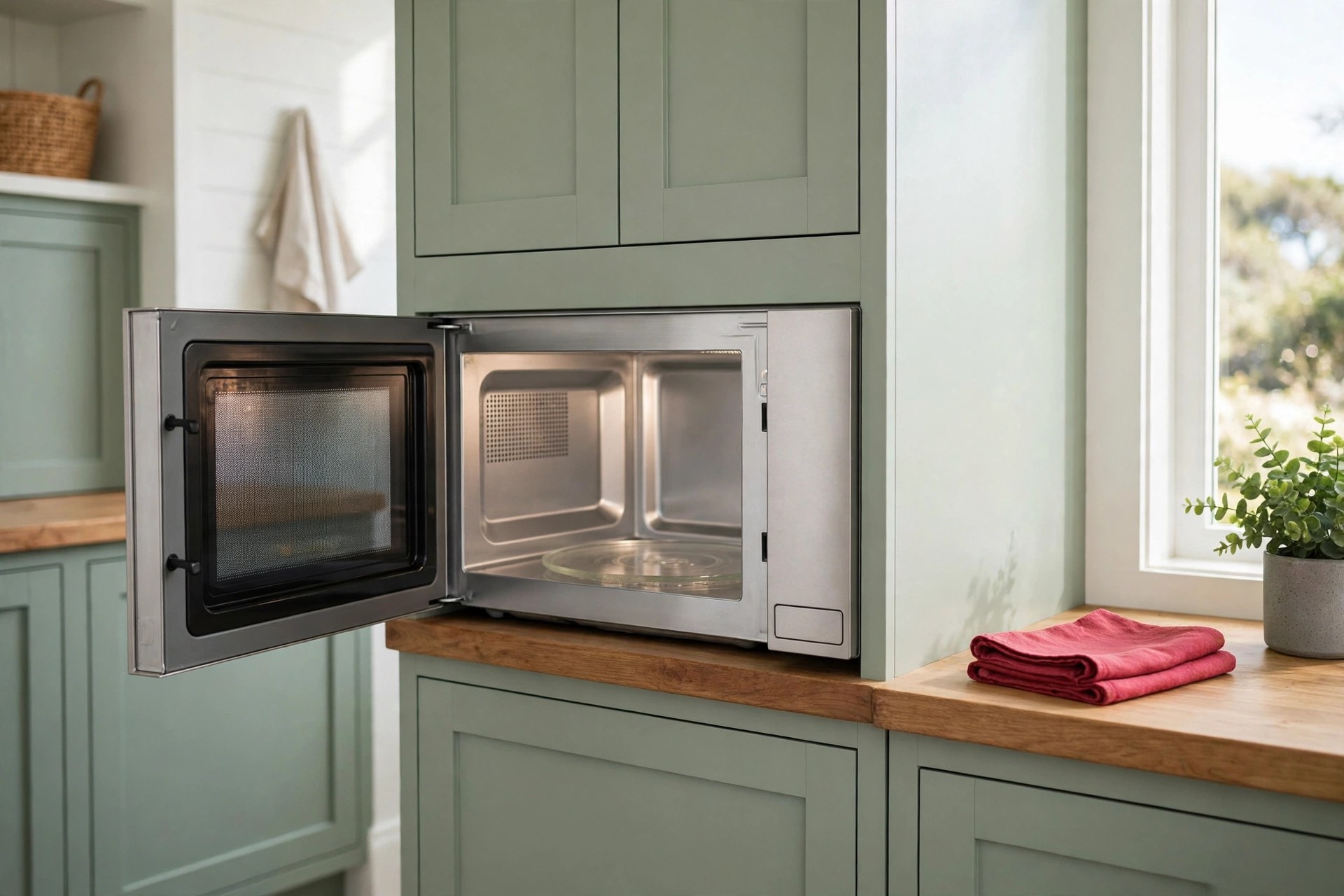
Seven types
Find your type first
Not sure which one you have? This is the quick way to tell.
01
Countertop (solo)
Sits on the bench, plugs into a wall socket
The difference
The simplest to care for: unplug, steam, wipe
02
Flatbed
No turntable; the floor is flat all the way across
The difference
No ring or track to clean; wipe spills where they land
03
Inverter or sensor
Says inverter or sensor on the front; defrosts evenly without hot spots
The difference
Cleans like a solo microwave; keep the touch panel dry
04
Convection or combination
Has a fan, a grill element or racks, and bakes and roasts
The difference
Grease like a small oven; racks and trays come out first
05
Over-the-range
Mounted above the cooktop, with a fan and lights underneath
The difference
Has a grease filter underneath that needs washing
06
Built-in
Fitted into a cabinet or wall unit, often with a trim kit
The difference
Clean it in place; never pull it out or remove the trim
07
Drawer
Slides out from under the bench like a drawer; food goes in from the top
The difference
Spills drip in from above; keep the cover on top clean
Type 01 of 07
Countertop (solo) microwaves
The difference
The simplest to care for: unplug, steam, wipe
The basic one, and still the most common. It sits on the bench, plugs into a wall socket, and does microwave cooking only: reheating, defrosting, steaming vegetables, popcorn. No grill, no fan oven.
Care is the simplest of all the types. Unplug it before you wipe it out, steam a bowl of water with lemon or vinegar to loosen spills, wipe the inside top down, and soak the glass turntable and roller ring in warm soapy water. Wipe the door, the seal and the control panel with a cloth wrung almost dry.
Two things to watch. First, keep the vents clear: a countertop microwave needs the ventilation space in its manual, so don't push it hard against the wall or stack things on top of it. Second, never box a freestanding model into a cabinet unless the maker says it is approved for that. Restricted airflow can make it overheat.
Type 02 of 07
Flatbed microwaves
The difference
No ring or track to clean; wipe spills where they land
A flatbed has no turntable. Microwaves are spread by an internal antenna instead, so the floor of the cavity is flat all the way across. Rectangular dishes fit properly, and there is no glass plate to lift out and wash.
That makes cleaning easier in one way and fussier in another. There is no roller ring or track to collect crumbs, so there is less to take apart. But spills sit exactly where they land, so wipe them while they are fresh. Once they bake on, a flat floor shows every mark.
Steam as usual, then wipe the whole floor in one pass. For a stubborn mark, a paste of bicarb soda and a little water, left for 10 minutes, works well on the flat surface. Check your manual before you use anything stronger: some flatbed floors have a coating that scratches easily.
Type 03 of 07
Inverter and sensor (smart) microwaves
The difference
Cleans like a solo microwave; keep the touch panel dry
An inverter microwave delivers steady power instead of cycling between full power and off, so it defrosts and cooks delicate food more evenly. A sensor model watches the steam coming off the food and adjusts the time itself. Smart models add touch controls, voice control or an app.
For cleaning, these are the same as a solo microwave. The cavity, turntable and seal are cared for the same way. The difference is the controls. Wipe a touch panel with a cloth that is barely damp, and never spray cleaner directly onto buttons or the display. Moisture getting into the electronics is the most common way to damage one.
Keep the vents clear and don't block the sensor: on sensor models it is usually a small opening on the inside wall. Wipe it gently with a damp cloth and leave it alone otherwise.
Type 04 of 07
Convection and combination microwaves
The difference
Grease like a small oven; racks and trays come out first
A convection or combination microwave adds a heating element and a fan, so it also works as a small fan oven. It can bake, roast and crisp food, not just reheat it. Combination models often come with racks or trays.
This is the type that gets dirtiest, because it cooks like an oven. Roasting meat and baking leave grease on the walls, ceiling and floor, and it bakes on faster because the element runs hot. Wipe it while it is still warm, not hot, after cooking. Grease left to cool and harden takes far longer to shift.
Take out the racks or trays before you clean, so you can reach every surface, and wash them separately in warm soapy water. Steam the cavity the same way as a solo microwave, then wipe. Check your manual for which racks suit which setting before you put them back. The outside can get hot while it runs in oven mode, so follow the clearances in the manual and keep tea towels and plastic away from it.
Type 05 of 07
Over-the-range microwaves
The difference
Has a grease filter underneath that needs washing
An over-the-range microwave mounts above the cooktop and doubles as the vent, with a fan and lights underneath. They are common overseas and less common in Australian kitchens, where most homes have a separate rangehood, but you will find them in some newer builds and renovations.
The inside is cared for like any other microwave. The extra work is underneath. There is a metal grease filter under the unit that catches cooking grease from the cooktop below. Wash it about once a month in warm soapy water, or in the dishwasher if your manual says it can go in, and let it dry fully before you put it back. If yours recirculates air instead of ducting it outside, it also has a charcoal filter. A charcoal filter can't be washed: it needs replacing when your manual says so.
Don't spray cleaner into the vents or the fan, and wipe the underside and lights with a damp cloth. If the fan is noisy, weak or not clearing steam, the filter is the first thing to check. Anything to do with the ducting or wiring is a job for a licensed tradesperson.
Type 06 of 07
Built-in microwaves
The difference
Clean it in place; never pull it out or remove the trim
A built-in microwave sits in a cabinet or a wall-oven column, often with a trim kit that frames it. It looks tidy and sits at a comfortable height, but it is wired in and fitted, so the care rules are mostly about what not to move.
Clean it in place. Switch it off at the wall or the circuit before you wipe around the controls, and use a cloth that is damp rather than wet, so no water runs into the cabinet or the trim. The steam method works the same as for a countertop model. Use a long-handled sponge or a step stool for the top corners, and take care with steam above you.
Don't pull it out of its cabinet and don't take off the trim. It is wired in, and moving or repairing it is a job for a licensed electrician. The same goes for any sparking, arcing, buzzing or door damage: switch it off and call a licensed electrician or the manufacturer.
Type 07 of 07
Drawer microwaves
The difference
Spills drip in from above; keep the cover on top clean
A drawer microwave slides out from under the bench or an island, and food goes in from the top rather than through a front door. They are easy to reach, especially for children and for anyone who doesn't want to lift hot dishes overhead, and they suit accessible kitchens.
Because food is loaded from above, spills and drips are more common than in a front-door microwave. Wipe the inside after each use, while spills are fresh, and steam it the same way as any other type when it needs more. Let the turntable and roller guide cool before you take them out, then wash them in warm soapy water or in the dishwasher if your manual allows it.
Keep the cover on top of the drawer clean. It is the inlet cover, the panel the microwaves come through, and keeping it clean helps avoid arcing and damage. Never remove it; wipe it gently in place with a damp cloth. Keep moisture out of the controls the same way as any touch-panel model.
What not to do, whatever the type
Don't run a microwave empty.
Don't use metal, foil or steel scourers.
Don't spray cleaner into the vents or the waveguide cover, the small panel inside the cavity. Wipe it gently and never remove it.
Don't use abrasive pads on the interior coating or the door glass.
Don't leave cleaner behind. Wipe over with a clean damp cloth at the end.
Don't keep using a damaged door. If it doesn't close properly, or the seal or hinges look damaged, stop using it and get it checked. That's a repair job, not a cleaning one.
Our guide to cleaning a microwave covers the steam method, stuck-on splatter, smells and the full what-not-to-do list in detail.
How often to care for each type
How you use it
A good routine
Reheating most days (any type)
Wipe spills the same day. Steam clean every 1 to 2 weeks.
Cooking in it, including convection roasting
Wipe while warm after each use. Steam clean weekly.
Over-the-range
Wash the grease filter about once a month, on top of the usual routine.
Occasional use or a holiday home
Steam clean after each guest stay or before you use it again.
Every type
Wash the turntable and roller ring once a month. A cover over bowls and plates cuts splatter, so there is less to clean in the first place.
What Ember & Leaf does for a microwave
With an oven clean
Microwave
$59
Cleaned in the same visit as your oven.
On its own
Microwave
$79
The minimum visit is $149.
Time
Microwave
15 min
Steamed, wiped, turntable washed.
If you'd rather not do it, we clean domestic microwaves from Tweed Heads to Ballina. We steam the inside to soften spills, wipe it out, wash the turntable and roller ring, and clean the door and controls, including the filter underneath an over-the-range model. It takes about 15 minutes. We never spray into the vents or remove the small panel inside (the waveguide cover), and we don't pull built-in models out of their cabinets.
A microwave is $59 when we clean it in the same visit as an oven, and $79 on its own. The minimum visit is $149, so a microwave on its own comes to $149. Most people add it to an oven clean for that reason. A 60cm oven ($229) with a microwave is $288, and you don't need to be home. See all prices, the rangehood, cooktop and microwave page or oven cleaning.
We clean domestic microwaves only, not commercial ones. Holiday-home hosts often add the microwave to a between-guests clean. Our Cleaning Club is free, with a reminder every 4, 6 or 12 months and 10 per cent off every clean.
Questions about microwave types
Does the type change how you clean it?
Mostly in the extras: the grease filter under an over-the-range model, the racks and oven grease in a convection microwave, the flat floor of a flatbed, and the trim on a built-in. The steam-and-wipe method itself is the same.
Can you clean a convection microwave?
Yes. We clean domestic convection and combination microwaves, including the racks and trays, in the same 15-minute visit. We don't clean commercial microwaves.
My microwave has no turntable. Is that a flatbed?
Yes. Flatbed models spread the microwaves with an internal antenna instead of a rotating plate, so the floor is flat. Wipe spills where they land, and there is no ring or track to clean.
Do you clean built-in microwaves?
Yes, we clean them in place, in the cabinet. We don't remove them or take off the trim: that needs a licensed electrician.
How much does it cost to have a microwave cleaned?
With Ember & Leaf it's $59 when added to an oven clean and $79 on its own, though the minimum visit is $149. It takes about 15 minutes.
Ready when you are
Get an exact price in about a minute. No obligation, no call-out fee.