Opening soon. Get your price and request a booking now, and a person will email you within one business day about a time that fits your days. You pay nothing until you pick a time.

Guide · Rangehoods
How to clean rangehood filters
To clean mesh or baffle rangehood filters, switch the rangehood off, lift the filters out, soak them in hot water with dish detergent or a kitchen degreaser for 15 to 30 minutes, scrub gently with a soft brush, rinse and dry them completely before refitting. Most kitchens need this every 1 to 2 months. Charcoal filters can't be washed and usually need replacing every 3 to 6 months.
Updated 20 November 2026 · Ember & Leaf, oven and BBQ cleaning from Tweed Heads to Ballina
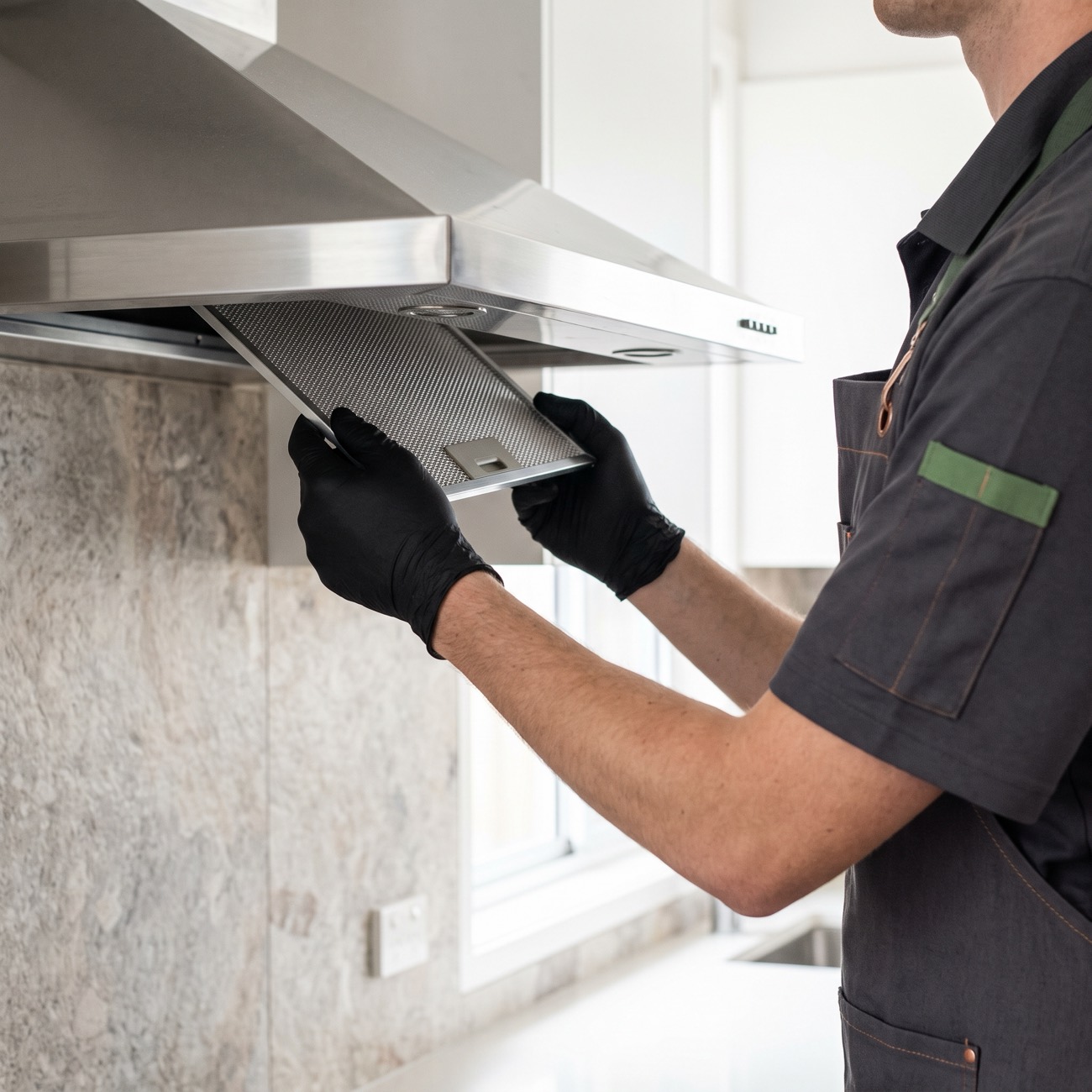
Which type of rangehood filter do you have?
Check this first, because the wrong method can ruin a filter. Most rangehoods have one of three types. Your manual will say which.
Filter type
What it looks like
Can you wash it?
How often
Mesh
Flat panel of fine layered metal mesh, often in a metal frame
Yes
Usually every 1 to 2 months
Baffle
Metal panel with slots or overlapping channels, usually stainless steel
Yes
Usually every 1 to 2 months
Charcoal
Dark, spongy or granular pad, often behind or above the main filter
No
Usually replace every 3 to 6 months
Charcoal filters are found in rangehoods that recirculate air back into the kitchen instead of venting it outside. If your rangehood has a charcoal pad, it sits in addition to the mesh or baffle filter, which you still wash. Don't soak the charcoal pad. Check the part number in your manual and order a replacement.
What you need
A sink or tub big enough for the filters (or a large roasting dish for small ones)
Hot water and dish detergent or a kitchen degreaser, used as the label says
A soft brush or an old toothbrush
Rubber gloves and eye protection if you're using a degreaser
A clean towel or a rack for drying
A stable step stool, so you're not reaching over a hot or wet cooktop
Skip wire brushes and steel wool. They scratch the filter and can shed loose wire bristles that end up in the sink, on your cooktop or in your food. Never mix different cleaning products, and open a window if you're using a degreaser.
How to clean mesh and baffle filters by hand
01
Switch it off. Turn the rangehood off at the wall or the switch, and let the cooktop cool. Most people can do this without touching any wiring.
02
Remove the filters. Most slide or lift out after you press a catch or latch. Support the filter with both hands, because grease can drip. Check your manual if it won't release, and don't force it.
03
Pre-wipe. Wipe off thick, loose grease with paper towel so the soak water doesn't turn to sludge.
04
Fill the sink with hot water. Use water as hot as your tap gives, and add dish detergent or a kitchen degreaser at the strength on the label. Boiling water can warp thin filters and is a scald risk, so it's usually best avoided.
05
Soak for 15 to 30 minutes. Fully cover the filters. For heavy, sticky grease, soak for up to an hour, or soak, scrub and soak again.
06
Scrub gently. Brush along the mesh or channels with a soft brush, both sides, working grease out of the corners. Change the water if it goes thick and cold.
07
Rinse well. Use hot running water until it runs clear and the filter doesn't feel slippery. Detergent or degreaser left in the mesh can attract dust.
08
Dry completely. See the drying section below.
09
Refit. Slide or clip the filters back in, check they sit flat and the catch clicks, then turn the rangehood on to check the fan runs.
Can rangehood filters go in the dishwasher?
Sometimes. It depends on the filter material and the manufacturer, so check your manual first.
Stainless steel baffle filters can usually go through the dishwasher on a hot cycle. Stand them upright so water gets between the channels, and don't stack other dishes against them.
Aluminium mesh filters can darken or discolour in a dishwasher, and some manufacturers say not to use one. If your manual doesn't say, hand washing is the safer bet for the filter.
Very greasy filters can leave a film on everything else in the machine and clog the dishwasher's own filter. A hot soak first, then a dishwasher cycle with nothing else in it, is a common compromise.
Charcoal filters never go in the dishwasher or the sink.
If you do use the dishwasher, run an empty hot cycle afterwards and check the dishwasher's own filter for grease.
Drying rangehood filters properly
Dry the filters fully before they go back in. Damp mesh holds on to grease and dust, and standing water in the channels can leave a film.
Shake off the water and stand the filters on end on a towel or rack.
Pat the frame and the edges with a clean cloth.
Leave them for a couple of hours in a ventilated spot, or until no moisture shows when you tilt them.
Don't dry them with a heat gun or in a hot oven. Thin frames can warp and the finish can discolour.
While the filters are drying, wipe the underside of the canopy and the filter slots with a cloth and warm soapy water. Don't spray into the motor area or any sealed electrical cover.
How often should you clean rangehood filters?
There's no single number, because it depends on how you cook.
Wok, frying, grilling or barbecuing indoors: usually every month.
Average home cooking: usually every 1 to 2 months, or when you see grease dripping or a smell when the fan runs.
Light use or a holiday home: every 2 to 3 months, or between guest changeovers if guests cook a lot.
Charcoal filters: usually replaced every 3 to 6 months. Check your manual.
A good test is to hold a filter up to the light. If you can't see through the mesh, or the baffle channels are sticky, it's overdue.
Cleaning the whole rangehood, including the canopy and fan housing, is usually worth doing once or twice a year as well.
When to stop and call someone
Some jobs are not DIY:
Burning smell or a humming motor. Turn the rangehood off and ask a licensed electrician to look at it.
Damaged cable, a loose or cracked electrical cover, or scorch marks. Don't touch them. Call a licensed electrician. In NSW, electrical repairs are licensed work.
A gas cooktop that lights unevenly or smells of gas. Turn the gas off and call a licensed gas fitter.
A filter that's bent, corroded or won't sit flat. Order a replacement with the right size and part number.
Don't remove the motor or open sealed covers yourself. Cleaning means filters, canopy and the surfaces you can reach.
What a professional does to the rangehood canopy
Filters are the easy part. The canopy and fan housing are where most DIY cleans stop, and where grease builds up quietly. Here's what we do on a rangehood clean:
01
Power off at the isolator.
02
Mesh and baffle filters out and into a hot soak, then degreased and dried.
03
The canopy cleaned inside and out, with the stainless finished along the grain.
04
The fan housing cleaned as far as we can reach with the filters out. We don't remove motors or open sealed electrical covers.
05
Filters refitted, then the fan and light tested.
If your rangehood has a charcoal filter, we can't clean it. We photograph the part number so you can order a replacement, and clean everything else.
What Ember & Leaf does for this job
We clean rangehoods from Tweed Heads to Ballina for a fixed $89 on its own, or $79 when we're cleaning your oven in the same visit. Each takes about 30 minutes. The price includes degreasing mesh or baffle filters and cleaning the canopy inside and out.
The minimum visit is $149, so a rangehood on its own comes to $149. Add it to an oven clean and it's the cheapest way to do it. A 60cm oven, cooktop and rangehood together are $387. There's no call-out fee and no travel fee from Tweed Heads to Ballina. Heavy build-up adds 20 per cent to that item (capped) and is shown on your quote before you book.
You don't need to be home, and photos before and after arrive with your receipt. In a holiday home, where filters are easy to forget between guests, that's a simple way to keep it ticking over. See rangehood and cooktop cleaning, all prices and how it works.
If you'd like a reminder so the build-up never gets heavy, join the Cleaning Club after your first clean. It's free, with a reminder every 4, 6 or 12 months and 10 per cent off every clean.
Questions about cleaning rangehood filters
How do you clean rangehood filters that are really greasy?
Wipe off the thick grease first, then soak the filters in hot water with a kitchen degreaser for up to an hour, scrub gently with a soft brush and repeat if needed. Follow the product label and wear gloves and eye protection.
Can you put rangehood filters in the dishwasher?
Stainless steel baffle filters usually can, on a hot cycle, but aluminium mesh can discolour. Check your manual, and never put a charcoal filter in the dishwasher.
How often should rangehood filters be cleaned?
Usually every 1 to 2 months for mesh or baffle filters, or monthly if you fry or wok a lot. Charcoal filters can't be washed and usually need replacing every 3 to 6 months.
Can you clean a charcoal rangehood filter?
No. Charcoal filters can't be washed, and soaking one will usually ruin it. Check the part number in your manual or on the old filter and order a replacement.
How long should I soak rangehood filters?
Usually 15 to 30 minutes for normal build-up, and up to an hour for thick, sticky grease. Scrub gently after soaking, rinse well and dry completely.
Is it okay to refit damp filters?
It's better to let them dry fully first. Damp filters hold on to grease and dust, and standing water in the channels can leave a film.
Does Ember & Leaf clean rangehood filters?
Yes. Rangehood cleaning is $89 on its own or $79 with an oven clean, and includes degreasing mesh and baffle filters and cleaning the canopy inside and out.
Ready when you are
Get an exact price in about a minute. No obligation, no call-out fee.