Opening soon. Get your price and request a booking now, and a person will email you within one business day about a time that fits your days. You pay nothing until you pick a time.

Guide · Ovens
Can you use oven cleaner on a self-cleaning oven?
Usually no. Most manuals say to keep caustic oven cleaner out of a self-cleaning oven, because it can damage pyrolytic enamel and catalytic liners. A pyrolytic oven normally needs a heat cycle of 2 to 4 hours, then a damp wipe of the ash. Catalytic liners should only be wiped. Check your manual first, because the rules differ between models.
Updated 20 November 2026 · Ember & Leaf, oven and BBQ cleaning from Tweed Heads to Ballina
Which self-cleaning oven do you have?
"Self-cleaning" covers three different things. What you can put on the oven depends on which one you own.
Oven type
How it usually cleans
Caustic oven cleaner?
Usually do this instead
Pyrolytic
Heats the cavity to around 450 to 500°C and turns grease to ash. The cycle usually runs 2 to 4 hours including cooling.
Usually not recommended. Check your manual.
Run the cycle, then wipe out the ash with a damp cloth.
Catalytic liners
Rough, porous panels on the sides and back that break down splatter while you cook at high heat.
Usually not recommended, and never scrub the liners.
Wipe lightly with a damp cloth. Use the high-heat burn-off your manual describes.
Steam or "aqua" clean
A short steam cycle, often 20 to 40 minutes, softens light, fresh spills.
Depends on the model. Check your manual.
Steam, then wipe. Heavier grease needs a hand clean.
Not sure which one you have? Look for a "pyrolytic", "catalytic" or "steam" label on the control panel, the manual or the manufacturer's website. A rough, speckled panel on the oven walls usually means catalytic liners. A smooth enamel cavity with a door lock that engages during a cycle is usually pyrolytic.
What the manuals usually say
Manuals vary, so yours is the final word. Many self-cleaning oven manuals include the same warnings:
Don't use commercial oven cleaners (or oven liner protectors) in or around the oven.
Don't scrub catalytic liners. Scouring pads, scrapers and abrasive cleaners can wear the porous coating.
Don't clean the door seal by scrubbing or with strong cleaners. Damaged or worn seals can let heat escape, and a pyrolytic cycle depends on a good seal.
Take the racks out before a pyrolytic cycle unless the manual says they can stay in. Heat can dull or discolour them.
Wipe out heavy spills before the cycle, so they don't smoke or flare.
Ventilate the kitchen during the cycle. Some manuals also have a warning about pet birds.
If you've lost the manual, search the model number on the manufacturer's website. It's usually printed on a plate inside the door frame or on the oven's side edge. Most brands put their manuals online as free downloads.
Why caustic cleaner and a pyrolytic cycle don't mix
A caustic oven cleaner is strong stuff. It's built for ovens with ordinary enamel, where you leave it on for hours and rinse it off. On a self-cleaning oven there are three usual problems:
01
Residue meets 450 to 500°C. If any cleaner is left in the cavity, a pyrolytic cycle can bake it on. That can mean smoke and smell, and sometimes a stain you can't get off.
02
The enamel can be damaged. Pyrolytic enamel is made to cope with heat. That doesn't mean it copes with every chemical. Strong cleaners can dull or etch it.
03
Seals, switches and the door lock are exposed. Overspray can reach door seals, the lock mechanism and the control area. Many manuals warn about this.
Etched or chipped enamel is damage, not dirt. Cleaning can't repair it, so it's much better not to cause it.
Why catalytic liners are even fussier
Catalytic liners work because the coating is rough and porous. Splatter soaks in and breaks down when the oven runs hot. That's also why they are easy to ruin.
A caustic cleaner can clog the pores or strip the coating.
Scrubbing wears it away.
Once a liner is spent or clogged, it usually can't be restored. Manufacturers often sell replacement panels, so look up your model.
If the liners are stained, a catalytic oven usually asks for patience. Run the oven hot as the manual describes, wipe the liner gently with a damp cloth once it's cool, and don't chase every mark. A liner that's visibly stained can still be working. Heavy fat can overwhelm them, though, and the rest of the oven (door, floor, racks) still needs a hand clean.
What to use instead
For most self-cleaning ovens the answer is a gentler method, used a little more often. Here is the usual approach for a pyrolytic oven. Check your manual for the specifics.
01
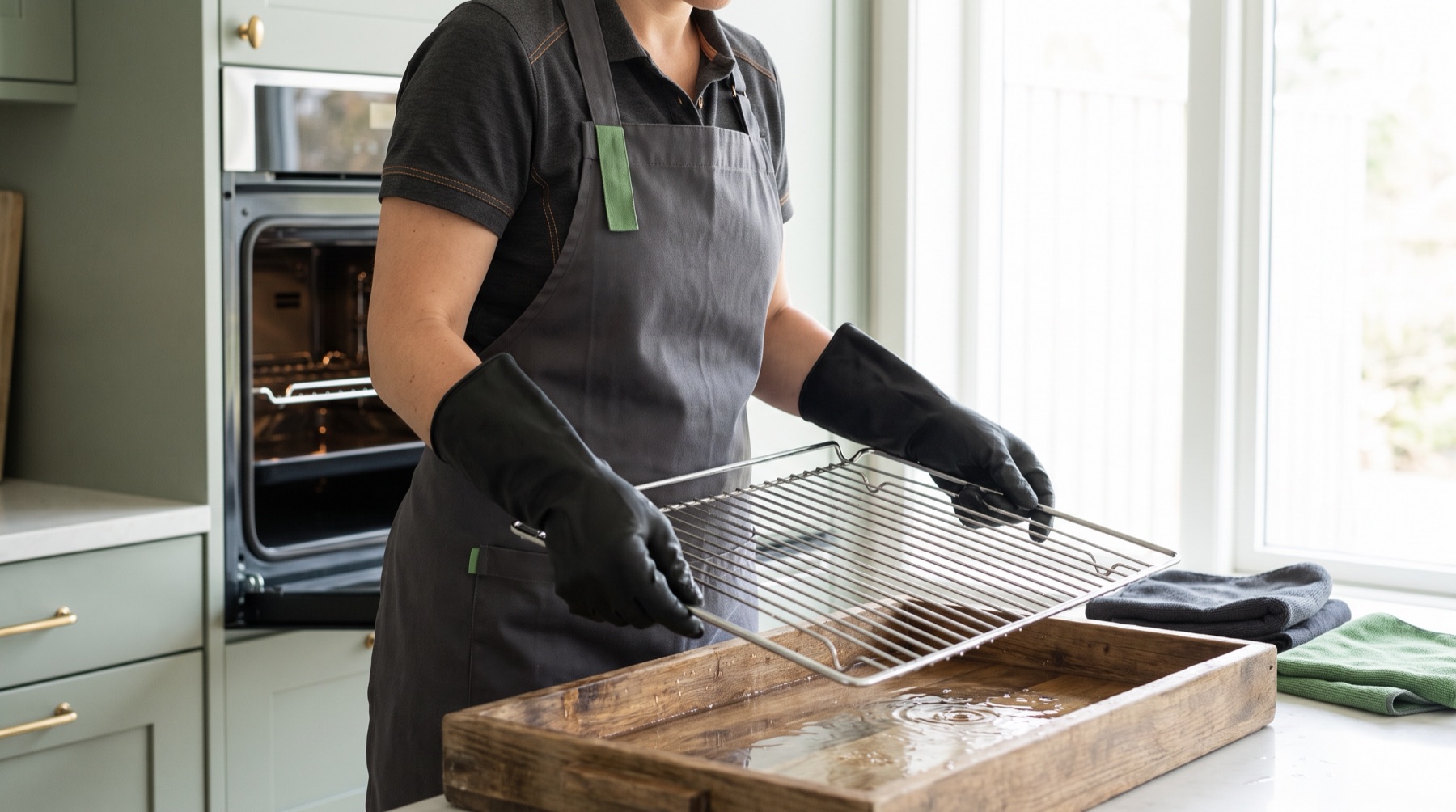
Take out the racks, trays and anything loose. Wash the racks separately in a laundry tub or bath with hot water and dishwashing liquid. Don't put them back until after the cycle.
02
Wipe out loose crumbs and thick spills with a damp cloth. Large pools of fat can smoke or flare in a cycle.
03
Open the kitchen windows and run the rangehood on a high setting.
04
Start the pyrolytic cycle at the setting your manual suggests. It usually runs 2 to 4 hours and the door stays locked until the oven cools.
05
Leave it alone until it's cool and the lock releases. Don't force the door.
06
Wipe out the ash with a damp cloth or sponge. Rinse the cloth often. If ash is stubborn, a little bicarb soda paste usually helps lift it, but check your manual first.
07
Wipe over again with a clean damp cloth and dry it. Then put the racks back.
For a catalytic or steam oven, skip the heat cycle and follow your manual. Usually that means a damp cloth, a little dishwashing liquid and a soft sponge on the enamel parts, and a light wipe only on the liners.
The parts a self-clean cycle misses
Even a good pyrolytic cycle only cleans what the heat reaches. These parts usually need a hand clean:
The racks and trays. They normally come out before the cycle, so they need washing separately.
The door seal area. The seal sits outside the hot zone, so grease builds up around it. Check your manual before cleaning near it, and don't scrub the seal itself.
The outside of the door and the front panel. Grease and fingerprints collect here.
Between the door glass. Most modern oven doors have two or three panes. The brown streaks live between them, and the cycle can't reach in.
Knobs, handle and the fan cover. They're outside the cavity or removable, and they pick up grease over time.
The grill compartment on ovens that have one.
The door glass usually beats a home clean, because most people don't take the door apart. If you do try, photograph each step so the panes go back in the right order. If you aren't sure, leave it to a professional.
If you've already sprayed oven cleaner in
It happens. Here's what people usually do, but check your manual or ask the manufacturer.
01
Don't run a self-clean cycle yet. Heat plus leftover product is the problem.
02
Wear gloves and eye protection and keep the kitchen well ventilated.
03
Wipe out all the product with a clean damp cloth, rinsing the cloth often. Repeat with fresh water several times. Follow the label on the product you used.
04
Dry the oven and leave the door open for a while.
05
Contact the manufacturer if you sprayed on the liners, the seal or the control area. They can tell you what's covered and what isn't.
Safety, and when to call a licensed tradie
Keep the basics in mind whichever method you use. Wear gloves and eye protection with any strong cleaner. Ventilate the kitchen. Follow the label on anything you use. Turn the oven off and let it cool before wiping inside.
Don't try to fix an oven yourself if something's wrong. A door that won't unlock after a cycle, an error code that keeps coming back, a burning smell with no cause, damaged wiring or a cracked glass panel are all jobs for the manufacturer or a repairer. In NSW, electrical work needs a licensed electrician and gas work needs a licensed gas fitter. If you smell gas, turn it off at the bottle or meter, open the windows and call a licensed gas fitter or your gas supplier.
What Ember & Leaf does with a self-cleaning oven
We clean pyrolytic and catalytic ovens. On a pyrolytic oven we treat the enamel gently with no blades, and clean the door, the seal area and the racks, which the cycle doesn't reach. On catalytic liners we wipe only and never scrape. Racks, trays and door glass come out and go in a heated soak in our van, and the cavity is cleaned by hand with a cleaning paste. Then we rinse twice, put it all back and run a quick heat test.
The price is fixed: $229 for a 60cm oven and $259 for a 90cm oven, in about 2 to 3 hours, with no call-out fee from Tweed Heads to Ballina. Heavy build-up adds 20 per cent to that item (capped), and it's shown on your quote before you book. You don't need to be home, and you get photos before and after with your receipt. The cycle can lock you out of your kitchen for hours. A hand clean while you're out can suit a busy holiday home between guests.
See oven cleaning for what's included, how it works for the process, or all prices. Cleaning Club members get 10 per cent off every clean and a reminder every 4, 6 or 12 months. The Cleaning Club is free.
Questions about oven cleaner and self-cleaning ovens
Can you use oven cleaner on a self-cleaning oven?
Usually not. Many manuals say not to use commercial oven cleaners on a self-cleaning oven, because they can damage the enamel or liners. Check your manual for your model.
Can you use oven cleaner on catalytic liners?
Usually not. The coating is porous and rough, and strong cleaners or scrubbing can clog or wear it. Wipe lightly with a damp cloth instead.
What happens if you run a pyrolytic cycle with oven cleaner left inside?
Leftover product can bake on at 450 to 500°C, which can mean smoke, smell and stains. Wipe out all product with clean damp cloths before any cycle, and ventilate the kitchen.
What can I use to clean a self-cleaning oven instead?
Usually the heat cycle (for pyrolytic ovens) followed by a damp cloth for the ash. Warm water with a little dishwashing liquid and a soft cloth works for light marks, and the racks can be washed separately.
Does a self-cleaning oven clean the door glass?
Not between the panes, and not the outside of the door or the seal area. Those usually need a hand clean, and the glass often comes apart for that.
Can Ember & Leaf clean a self-cleaning oven?
Yes. We treat pyrolytic enamel gently with no blades, wipe catalytic liners only, and clean the door, seal area and racks. A 60cm oven is $229 and a 90cm oven is $259, fixed.
Should I run the self-clean cycle before or after a professional clean?
It's usually best to book the clean and leave the cycle out. If you've run a cycle recently, mention it in your notes. Photos with your enquiry help us price it exactly.
Ready when you are
Get an exact price in about a minute. No obligation, no call-out fee.